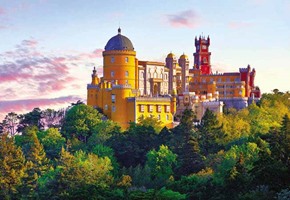
Sintra
The old Moorish city of Sintra, which was recaptured in 1147 by
the Portuguese King Alfons I, has been the summer residence of the
Portuguese kings and the aristocracy for more than 600 years. Today
Sintra is popular with visitors thanks to its mild, humid climate
and its picturesque location below the small coastal mountains,
Sierra de Sintra, which rise sharply above the city. The city's
most recognisable landmark is the National Palace (Palacio
Nacional), with its huge white twin chimneys that rise above the
large palace kitchen, and are visible from across the city and
surrounding region.
The palace is regarded as one of the most important examples of
regal architecture in Portugal and has been classified as a
National Monument. The palace was continuously inhabited as a royal
summer residence from the 14th to the 20th century. It boasts a mix
of different architectural styles, with elaborate wood-carved
ceilings and marvellous wall decoration with ceramic tiles from the
15th/16th centuries. The tiles, which were manufactured in Seville,
form the oldest and most extensive collections on the Iberian
Peninsula.

 River Cruise